
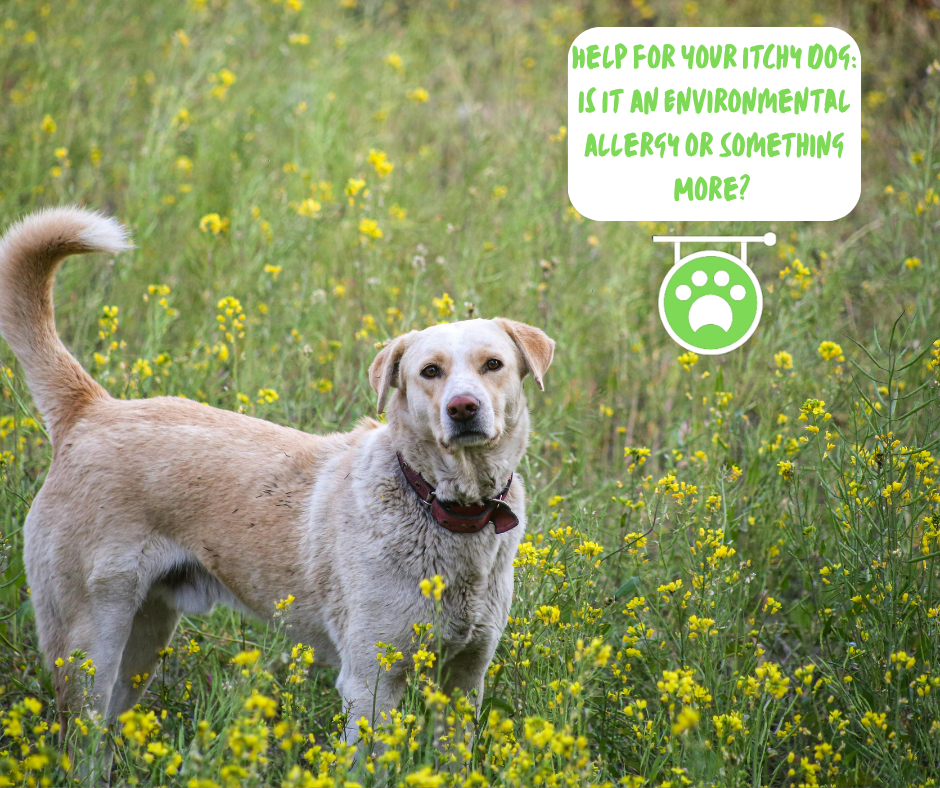
Often the first time people consider that their dog might have allergies, it’s because they see their dog itching and scratching. But every itchy dog doesn’t have allergies. Yes, scratching is an indication that there’s a problem, but not necessarily allergies. Still, let’s talk about environmental allergies that could affect your dog.
.
For environmental allergies, in most cases you’re talking about pollen. This is what used to be traditionally called hay fever – it was hay pollen, mostly caused by whatever fell to the ground.
.
Why is this such a problem for dogs? Look how tall your dog is compared to how tall you are. You don’t walk around with your face down at ground level like dogs do. So if it’s environmental allergies, your dog walks along outside, fills his face full of pollen, and his body starts itching. It does not just affect his face. It can. It can cause red eyes. Swollen muzzle. But sometimes it makes the rest of the body itch, too.
.
This is why I like bathing your dog as a first step to address allergies. If your dog is allergic to pollen, give him a bath and if the itching stops… Bingo! You figured out that it’s environmental allergies. It’s a really quick and easy diagnostic test.
.
But don’t use oatmeal shampoo because anybody who’s allergic to oatmeal on the inside is allergic to oatmeal on the outside. Stay clear of those veterinary products that are supposedly called shampoo. Why? Because they are made of really incredibly harsh chemicals that can absorb through the skin and cause problems for either the human or the dog or both. (want more? See my post about soap.)
.
Back to my point- if a bath makes the itching go away, then the cause of the itching is often environmental allergy.
.
Now, there are times when environmental allergies aren’t the problem and a bath won’t fix it. Some dogs have really itchy skin because their biome (gut flora) is so screwed up that the imbalance in the gut is affecting the little guys crawling around on the skin. These same dogs will have some improvement from a bath, simply because you’re washing the bacteria and yeast that creates itch off of the skin.
.
The other thing that helps you determine if it’s environmental allergy is if it’s seasonal. Where are you in the country? The world? Some of you have snow as I’m writing this. But oak trees are pollinating in Florida right now. Something’s blooming in California. Your season may be different than somebody else’s season. But if you get to the end of the season and the itch stops, then you know that it’s environmental.
.
Some other cues of environmental allergies:
- They tend to show up around three years of age. Because the first year the body sees the pollen and it thinks. “Oh. OK.” The second time the body sees the pollen, it thinks “Well. I guess it’s OK.” And the third year the body sees the pollen, it says. “No. I’m not having this. It’s gonna drive me crazy.”
- And if you’ve ever tried that injection that western medicine veterinarians, give to stop the itch – C650po1nt – and it last the first time all the way till next year. It’s environmental. And then it starts to be less than less effective. But it is a useful tool if you have succumbed to the Western medicine regime. (By the way, all that shot does is tells the body not to scratch. It does nothing to treat the underlying symptoms. It does nothing to stop the histamine cycle. It does nothing to treat the underlying cause. It’s simply gives symptomatic relief. Sometimes.)
.
So that’s environmental allergies explained. That’s why it’s so important to question how to “treat” the problem. And I did give you one suggestion above. A bath. Always start there. I’ll give you more details in another post.
.
Consultations available in Tampa, Clearwater and virtually for pet owners seeking natural wellness solutions.