
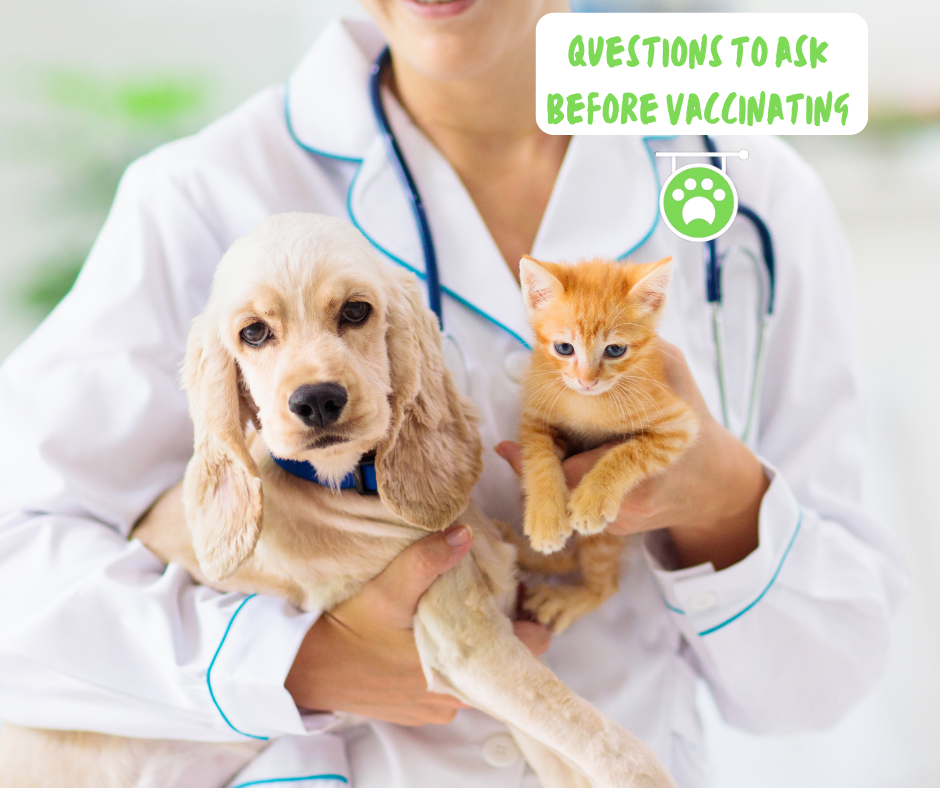
 So you got a new kitten or puppy.
.
And you want to do everything right.
.
You have the information given by the breeder – what the breeder thinks is right.
.
You have the information given by the veterinarian that was required to examine your new kitten/dog three days after you brought it home – what the veterinarian thinks is right.
.
But it’s all of this information, correct?
.
Or are all of these people just parroting what they’ve been told?
.
Because veterinary hospitals have “policies“. Their policies are partly based on science, most definitely based on what the vaccine companies recommend, and absolutely based on, gaining the most profit at the veterinary clinic.
.
And the breeders have been trained by the veterinarians, the vaccine companies, but also their personal experience. It depends on if the breeder has had problems with parasites in the puppies. It depends on if the breeder has had problems with parvovirus. It depends on if the breeder has had respiratory virus in the cattery. It depends on if the breeder has followed the health of their animals for the last 15 years and wants to prevent future problems.
.
So, it depends on what breeder you used for what information the breeder promotes.
.
So now you’re sitting with this new animal, and you’re asking yourself “what do I really need to do?”
.
So the following information is the same, it does not matter your velocity about vaccines in humans or animals . I’m not going to try super hard to sway you one way, or the other. I just want you to have the facts so you can make better decisions. (I’ll save swaying your opinion for an office or virtual visit – although it’s ultimately still your decision.)
.
Once that is your pet, there’s one vaccine required by law. Only one. Rabies.
.
Most of the time the law states that once an animal is four months of age or older, it can receive the first rabies vaccine. Most of the time, the laws are now written such that one year later that pet is allowed to be vaccinated with a three-year vaccine that can be booster every three years.
.
That is the only vaccine required by law.
.
It is now, finally, generally accepted that less vaccines are better than more vaccines. Because they can have side effects.
.
So, let’s talk about vaccines in general. The vaccine is essentially a one size fits all. This is rabies, the distemper combo, that dogs get, the respiratory combo that cats get, and those funky, vaccines that are optional, and I’m not even going to list them.
.
So it doesn’t matter if your pet weighs 2 pounds, or 200 pounds, they get the same dose.
.
There’s absolutely a connection with little animals having reactions to vaccines more than big animals.
.
Back to the vaccines themselves.
.
So now you know what’s required by law.
.
No other vaccine is required by law.
.
Any other vaccine that is “required” by the veterinarian, the groomer, the boarding facility, or even the trainer, is all personal preference of those people.
.
Groomers, boarding facilities, veterinarians and even trainers think that requiring vaccines prevents disease in their facility. This is what they are trying to prevent! They are trying to protect their liability.
.
In most cases, it’s the Bordetella vaccine that they are requiring to prevent kennel cough, the disease that comes from the Bordetella.
.
Most veterinarians will tell pet owners that the kennel cough vaccine does not prevent kennel cough. It reduces clinical symptoms. Which is why, in spite of having strong vaccine, policies; groomers and boarding facilities, still see kennel cough in their facility. It’s not because it’s a dirty facility. But it’s because kids get cooties when they go to daycare – which means that a bunch of animals in a high stress environment are more likely to share viruses.
.
OK, so some of you are having a conniption right now, because you want me to talk about the distemper combination for dogs. The cat vaccine is sometimes called distemper, but it’s really a respiratory vaccine because it prevents respiratory disease.
.
Here’s basic information we were taught in immunology class in the second year of veterinary school.
.
It takes the body 2 to 3 weeks to respond to a vaccine after the vaccine is administered. So, if your new pet is given a vaccine today, goes to see the Vet in three days, it’s absolutely inappropriate for that veterinarian to give a “booster“ of the exact same vaccine at that three day visit because it’s still figuring out what to do with the vaccine it got three days ago. Instead, that veterinarian needs to schedule a follow up appointment 3 to 4 weeks from now; that’s assuming that you, as the owner, decide that you want to give these vaccines that are not required by law.
.
25 years ago, when I went to Vet school, we were told that when the kitten or the puppy was born it nursed from its mother and received antibodies in the mothers milk. We were told that these antibodies can last up to 16 weeks. This is all still true. But what’s cool with modern science is now we have an ability to test the blood of the mother when she’s pregnant, and ask how long those antibodies will last.
.
What does this mean?
.
It means if I’m a breeder, and my bitch is pregnant, one to two months before she is due to deliver, I’m going to do a blood test and see how long her antibodies should last. If they’re going to last for 12 weeks, then I will tell the owners of the future puppies that 12 weeks of age would be an ideal time to give a distemper parvo vaccine, if they want to give that vaccine.
.
There’s some research that says that that one vaccine may give lifelong protection. There’s some research that says a follow up booster in one month gives slightly stronger protection. But again, that protection, just might last for life.
.
You can do titer testing to check for presents of antibodies. That’s your test that “proves“ that the body responded to a vaccine.
.
Getting back to the basics:
.
A series of four vaccines for the purpose of doing a series of four is inappropriate (this is what hospital policies often look like).
.
Every animal is different .
.
We need to look at the age of the animal, look at what has happened before, and look what the owner wants to do in the future. It’s now your pet. It’s now your decision.
.
Still seeing patients in Tampa,Clearwater, and virtually.